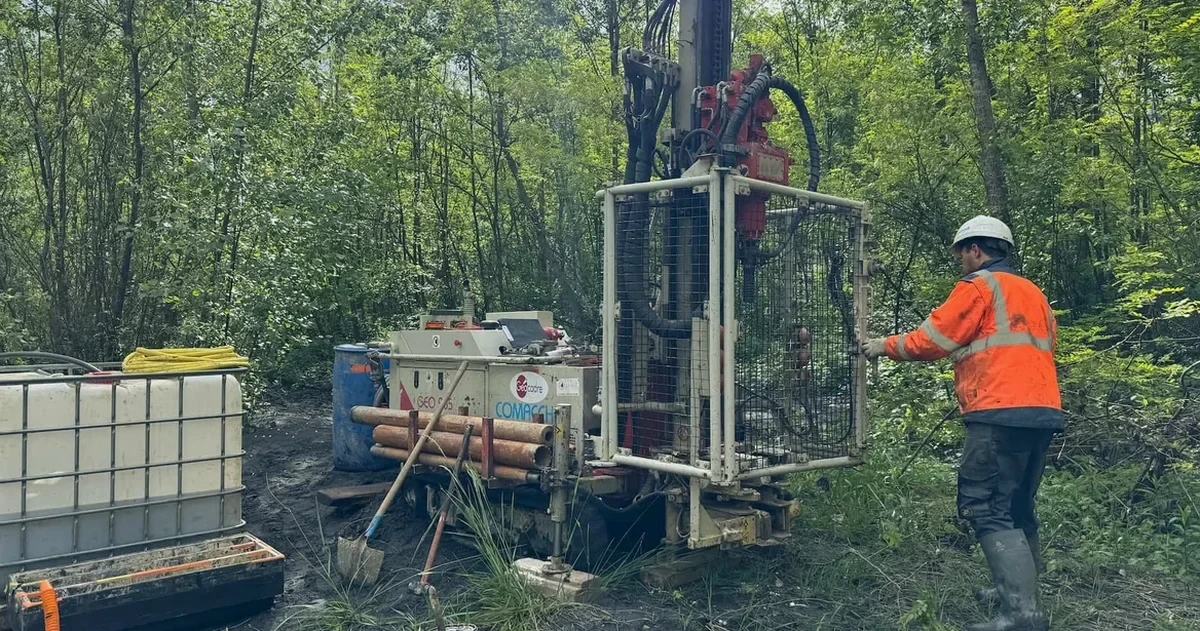
Miami sits on a geological layer cake of oolitic limestone, compact sands, and organic silts deposited during Pleistocene sea-level changes. The Fort Thompson Formation underlies much of the city, but its solution-riddled surface creates real headaches for foundation design. Drill 15 feet in Coral Gables and you might hit competent Miami limestone; drill the same depth in Doral and find loose quartz sand with groundwater at 4 feet. This variability makes a soil mechanics study indispensable before any deep excavation or high-rise project. We run a full suite of ASTM D2487 classification, triaxial and consolidation tests, and correlate field SPT data with lab index properties to build a stress-strain model of the subsurface. When a site straddles the transition between the Atlantic Coastal Ridge and the Everglades basin, we also integrate CPT test results to pin down thin compressible lenses that standard borings can miss.
Miami's biggest geotechnical challenge is not just soft ground — it's the unpredictability of dissolution features in the limestone caprock.
How we work
Miami-Dade County processes over 15,000 building permits annually, and the 2023 Florida Building Code (FBC) incorporates IBC Chapter 18 with local amendments for high-velocity hurricane zones. A compliant soil mechanics study must deliver bearing capacity calculations, total and differential settlement estimates, and lateral earth pressure coefficients for basement walls or retention systems. Our lab runs consolidated-undrained triaxial tests on shelly sand specimens to capture the strength loss when pore pressure builds during rapid loading — critical for coastal sites where storm surge saturates the vadose zone. We prepare geotechnical reports with factored resistance values ready for threshold inspector review, including liquefaction screening per ASCE 7-22 where the standard penetration resistance drops below 15 blows per foot in loose aeolian deposits west of Krome Avenue.
Site-specific factors
Compare two sites: one in Coconut Grove on weathered oolitic limestone with pinnacles and solution pipes, another in Sweetwater on 20 feet of loose quartz sand overlying organic peat. The Grove site looks solid at surface but can hide a 10-foot void 15 feet down — a drill rig drops the rod suddenly, and you realize the planned 24-inch augercast pile has no bearing stratum. Sweetwater looks soft, but with a proper soil mechanics study we design a rigid mat foundation that limits differential settlement to half an inch across the slab. Skipping the lab phase — Atterberg limits, consolidation curves, direct shear on undisturbed shelly samples — turns these local quirks into change orders and cracked shear walls. Miami's code officials will red-tag a project lacking a geotechnical report stamped by a Florida-licensed engineer.
Common questions
How much does a soil mechanics study cost for a single-family home lot in Miami?
For a standard residential lot under 10,000 square feet, the complete study — including one SPT boring to 25 feet, lab classification, and a signed geotechnical report — runs between US$3.450 and US$4.460. The final number depends on access conditions, groundwater depth at time of drilling, and whether we encounter limestone refusal requiring rock coring.
Does Miami-Dade County require a geotechnical report for a building permit?
Yes. The Florida Building Code (Section 1803) and Miami-Dade amendments require a geotechnical investigation for all new structures except minor accessory buildings. The report must be sealed by a Florida Professional Engineer and include bearing capacity, settlement estimates, and soil classification per ASTM standards.
How deep do you drill for a soil mechanics study in Miami?
We typically drill to 30 feet below grade for low-rise structures, or 60 to 100 feet for mid-rise and high-rise buildings. The depth follows the IBC requirement of exploring through all compressible strata until we reach competent bearing material — usually Miami limestone or dense quartz sand with N60 values above 30.
What is the biggest soil problem you encounter in Miami that could delay construction?
Unmapped dissolution features in the Miami limestone. Voids and pinnacles formed by rainwater percolation can go undetected with widely spaced borings. When we hit an anomaly, we recommend a closer boring grid or geophysical profiling to map the rock surface before foundation excavation begins.