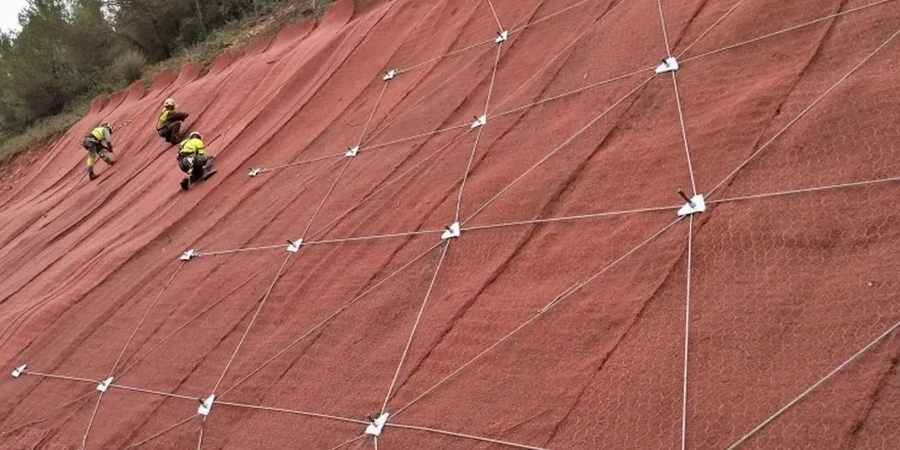
Miami sits on a geological knife-edge. The IBC and ASCE 7-22 mandate specific safety factors for cut and fill operations, and here in South Florida, the subsurface doesn't forgive. You're dealing with the Fort Thompson Formation—porous limestone riddled with solution cavities—overlain by loose quartz sand and layers of organic peat. A standard slope stability analysis in this city must account for rapid drawdown conditions after a tropical storm, the weight of saturated surficial sands, and the sudden loss of cohesion when the water table fluctuates. We apply limit equilibrium methods (Bishop, Spencer, Morgenstern-Price) calibrated to the Florida-specific stratigraphy, not generic textbook models. Before a grader breaks ground on a canal bank or a retention pond, the numerical model needs to reflect the real stratigraphy of Dade County. We complement the core assessment with CPT testing when we need a continuous profile of tip resistance through those interbedded lenses, and with stone columns when the analysis reveals a deep-seated failure surface that demands ground improvement before benching.
In Miami, the critical failure surface is rarely a textbook circular arc; it's a compound slide riding the interface between the sand and the irregular limestone caprock.
Site-specific factors
Compare a site in Coral Gables with one in Doral. In Coral Gables, you're often cutting into competent oolitic limestone, and the stability is controlled by the orientation of near-vertical joints; a wedge failure is your main concern, and the analysis hinges on the persistence of those discontinuities. Drive fifteen miles west to Doral, and the situation flips entirely. You're sitting on thick deposits of compressible organic silts and loose sands near the water table. The risk there isn't a sudden rockfall—it's a deep-seated rotational failure that creeps under the weight of a fill embankment, especially if the preconsolidation pressure of the underlying peat is exceeded. This contrast means the geotechnical investigation can't be a boilerplate template. In the western basins, we calibrate the model using CPTu pore pressure dissipation data to catch the low effective stress zones. The risk multiplies when developers try to steepen a slope to maximize the buildable footprint on a tight lot in Brickell, where a sudden loss of suction in the partially saturated sand during a summer downpour can reduce the factor of safety below 1.0 in a matter of hours.
Common questions
What is the minimum factor of safety required for a permanent slope in Miami-Dade County?
The Florida Building Code (IBC 2021) requires a minimum static factor of safety of 1.5 for permanent cut slopes. For seismic conditions, a pseudostatic analysis per ASCE 7-22 typically requires a minimum factor of safety of 1.1. These values must be verified by a Florida-licensed professional engineer based on site-specific subsurface conditions.
How do you model the risk of sinkholes in a slope stability analysis?
In Miami's karst terrain, we incorporate the potential for raveling and cavity collapse into the stability model. We use the results of electrical resistivity imaging or ground-penetrating radar to map anomalies in the limestone. If a cavity is detected near the slope face, we model the progressive failure by assuming a sudden loss of support and checking the resulting stress redistribution in the overlying sand.
What is the typical cost range for a slope stability analysis in Miami?
A comprehensive slope stability analysis, including field drilling, laboratory triaxial testing, and the numerical modeling report, typically ranges from US$1,120 to US$4,580 depending on the slope height, the complexity of the stratigraphy, and the number of cross-sections analyzed.
How does hurricane rainfall affect the analysis of a cut slope?
The intense rainfall from a Miami hurricane saturates the surficial sands, eliminating the matric suction that provides apparent cohesion. We run transient seepage analyses (using SEEP/W coupled with SLOPE/W) to track the wetting front as it advances into the slope. The critical time step is often 6 to 24 hours after the storm begins, when the factor of safety typically reaches its minimum before the pore pressures begin to dissipate.