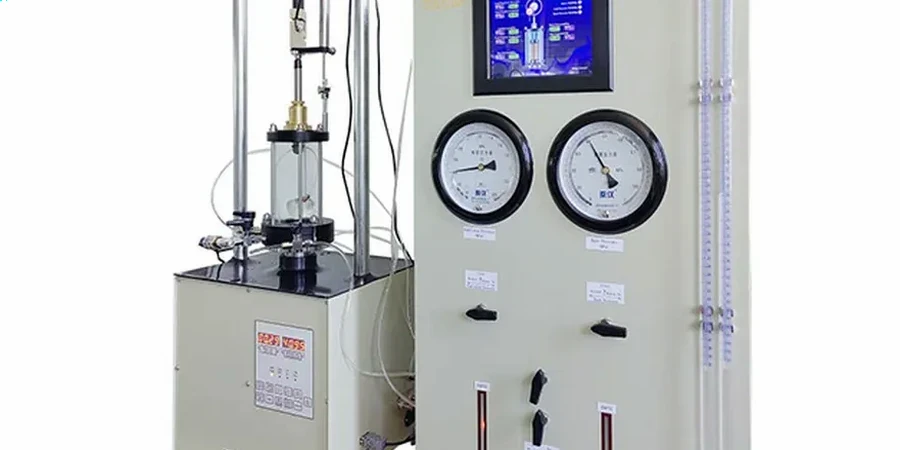
Miami’s geology is a constant negotiation with water. The Biscayne Aquifer sits just a few feet down, and the oolitic limestone alternates with layers of loose sand and organic silt. That combination demands more than a standard index test when you’re designing deep excavations or waterfront structures. A triaxial test lets us simulate the exact confining pressures your soil will feel under load, with pore pressure measurement baked into the procedure. For projects near the Miami River or along the barrier islands, we often pair it with in-situ permeability testing to capture the full hydro-mechanical picture. With a population exceeding 440,000 and construction pushing into reclaimed wetlands, understanding effective stress isn’t optional anymore — it’s the difference between a foundation that settles predictably and one that surprises you.
Knowing the effective friction angle of Miami limestone fill can cut your retaining wall costs by double digits — if you test it right.
Site-specific factors
Miami’s building boom since the 1920s has left us with a patchwork of subsurface conditions — natural marine sediment here, a forgotten dredge pit there, and plenty of undocumented fill in between. When we get called to a site near Overtown or Edgewater, the borelog often reveals material that doesn’t behave like anything in the county soil survey. A consolidated-undrained triaxial test on that fill can expose contractive behavior that standard blow counts miss entirely. The cost of skipping it shows up later as differential settlement or, in the worst case, a shear failure during excavation. If the project involves a retaining wall taller than six feet or a basement level below the seasonal high groundwater, the triaxial data becomes the anchor of your geotechnical report — and the first thing the building department peer reviewer will ask for.
Common questions
What does a triaxial test cost in Miami?
A standard triaxial program in Miami — typically a set of three specimens at different confining pressures — runs between US$1,610 and US$2,570 depending on whether you need CU, CD, or both stages.
How long does it take to get triaxial results?
For CU with pore pressure measurement, expect five to seven business days after specimen preparation. CD tests take longer because the shear stage must be slow enough to prevent pore pressure buildup — plan on up to two weeks.
Do I need triaxial testing for a house foundation in Miami?
For a standard single-family home on a slab-on-grade, probably not — Atterberg limits and a bearing capacity check usually suffice. But if you're building a multi-story structure, a basement, or anything on fill near the coast, triaxial data gives your engineer the effective stress parameters required by IBC Chapter 18.
How do you handle Miami's high water table during specimen preparation?
We trim and mount the specimen at its natural moisture content, then apply back-pressure saturation in the cell until the Skempton B-value exceeds 0.95. This replicates the fully saturated condition your soil will experience in situ, which is critical for getting reliable effective stress paths.