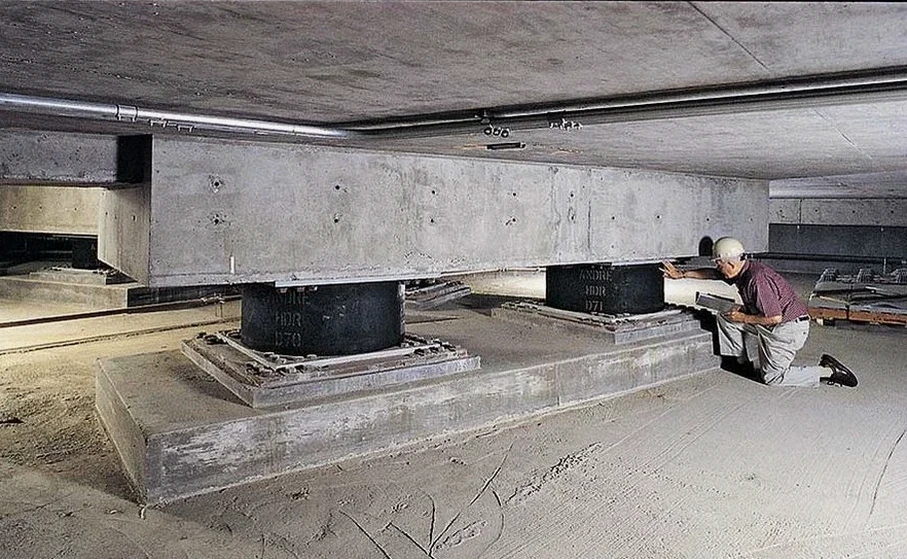
Miami's skyline transformed dramatically after the 1920s boom, expanding onto barrier islands and reclaimed marshland with little thought to seismic vulnerability. While Florida isn't California, the region sits atop a deep sedimentary basin where distant Caribbean earthquakes generate long-period waves that resonate dangerously with tall buildings. Base isolation seismic design offers a proven engineering countermeasure, decoupling the superstructure from foundation motion through elastomeric bearings and sliding systems. Our team applies this technology to hospitals, data centers, and high-value coastal structures, integrating local liquefaction assessment data to ensure the isolator displacement capacity exceeds the demands of amplified soft-soil ground motion.
In Miami's soft soil basin, a well-designed base isolation system can cut seismic force demands by 60 to 80 percent compared to fixed-base design.
Site-specific factors
A frequent mistake in South Florida is treating base isolation as a simple product specification rather than an integrated design process. Contractors sometimes procure isolators from catalogs without performing structure-specific prototype testing, leading to bearing stiffness values that don't match the dynamic model — a mismatch that can amplify, rather than reduce, story accelerations. Miami's corrosive coastal atmosphere adds another layer of risk: elastomeric bearings without adequate cover layers or stainless steel shims degrade faster than expected. Our protocol ties every isolator design to a full-scale test program per ASCE 7-22 Section 17.8, verifying horizontal stiffness, damping ratio, and stability under maximum considered earthquake displacements before the first bearing ships to site.
Common questions
Why would a building in Miami need base isolation when Florida isn't known for earthquakes?
Florida sits on a deep sedimentary basin that amplifies long-period seismic waves from distant sources — particularly the Caribbean and the New Madrid Seismic Zone. Tall and long-period structures in Miami can experience resonant amplification from these distant events, making base isolation a cost-effective strategy to protect critical facilities against rare but high-consequence ground shaking.
What does base isolation design cost for a mid-rise Miami project?
For a typical mid-rise structure in Miami, the engineering design and prototype testing package ranges from US$4,720 to US$8,460, excluding the isolator hardware itself. The investment often pays back through reduced structural steel and concrete quantities, lower floor accelerations protecting sensitive equipment, and insurance premium adjustments.
How do you handle Miami's high water table in isolated foundation design?
The isolation interface sits above a rigid basement or crawl space, so the water table itself doesn't contact the bearings. However, we specify marine-grade elastomer compounds and stainless steel shims to handle the ambient humidity. The moat and lower structure require continuous waterproofing, and we coordinate drain details with the structural drawings to prevent ponding around isolators.
Is prototype testing really required for every Miami project?
Yes. ASCE 7-22 Section 17.8 mandates full-scale prototype testing for each isolator type and size used on a project. Catalog values alone are insufficient because manufacturing variability in elastomer compounds and lead core dimensions directly affects stiffness and damping. We oversee the test program to ensure the as-built bearings match the dynamic properties assumed in the nonlinear analysis.