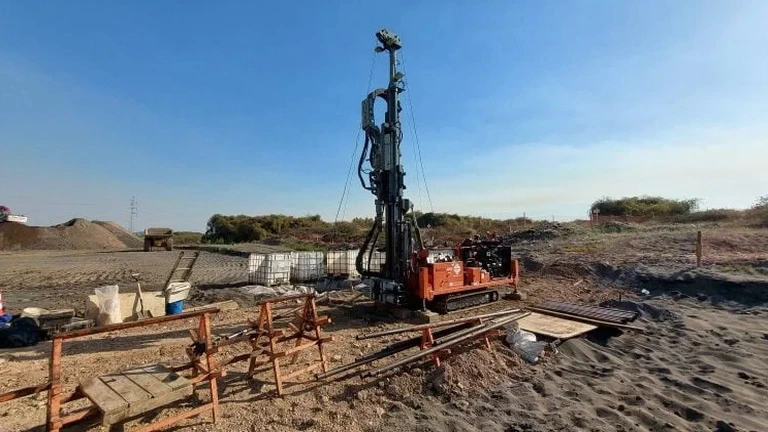
Miami presents two distinct excavation realities: the well-drained sands of the coastal ridge running through Coral Gables, and the saturated organic silts of the western Everglades fringe in Doral. What trenches easily near US-1 becomes a slurry collapse risk just five miles inland. Our exploratory test pit service bridges that gap by physically opening the ground and letting the project geotechnical engineer stand at the edge of the excavation to see the actual strata, water table, and any buried debris. Unlike a drill rig that recovers disturbed samples, a properly benched pit reveals true in-situ fabric, root penetration, and the contact between fill and natural limestone. We log every wall using ASTM D2487 classification and document groundwater infiltration rates on the spot, because in South Florida the water table often sits less than 1.5 meters below grade.
Seeing a four-meter vertical face in Miami Limestone tells you more about excavation stability than a dozen SPT blow counts alone.
Site-specific factors
A mid-rise residential project on the old Oolite rock ridge near Miami Avenue had strip footing designs based solely on SPT borings. When we opened three exploratory test pits, the upper 1.2 meters was loose urban fill with brick fragments, asphalt chunks, and undocumented sand lenses. The original boring logs missed the heterogeneity because the split spoon crossed the fill layer in 15 centimeters. The structural engineer revised the bearing depth to 2.1 meters, well into the limestone, after seeing the pit walls. That single day of field work prevented differential settlement that would have manifested as drywall cracks within the first wet season. In Miami's redeveloped neighborhoods, the historical fill layer is never uniform, and only a full-face exposure catches the pockets of organics or old coral rubble that compromise bearing capacity calculations.
Common questions
What is the typical cost range for an exploratory test pit in Miami?
For most Miami-area projects, a standard machine-excavated test pit with OSHA benching, logging, photography, and bulk sampling falls between US$440 and US$950. The final figure depends on depth, access constraints (like tight alleyways in Wynwood or Coral Way), and whether hand-digging is required near existing utilities. Projects east of I-95 often need vacuum excavation to clear underground electric, which adds a modest cost.
How deep can you go before Miami's water table becomes a problem?
In much of Miami-Dade County, the groundwater table sits between 0.9 and 1.8 meters below grade during the wet season. Our pits typically reach the water table, and we document the inflow rate and stabilized level. For deeper investigations below the water table, we transition to CPT or SPT drilling methods rather than attempting dewatered pits.
Do I need a permit from Miami-Dade DERM for a test pit?
For shallow exploratory pits that are backfilled the same day, a separate DERM permit is usually not required. However, if the pit intersects the water table and requires dewatering or if the site falls within a wellfield protection zone, additional coordination with county environmental resources may be needed. We advise on this during the project scoping phase.
What information does a test pit provide that a boring does not?
A test pit exposes a continuous vertical face, revealing soil fabric, stratification contacts, root penetration, and fill heterogeneity that can be missed by a 2-inch split spoon sample. In Miami's urban fill zones, this visual evidence of debris, coral rubble, or organic seams directly informs footing depth revisions and avoids the risk of interpolating between discrete SPT samples.