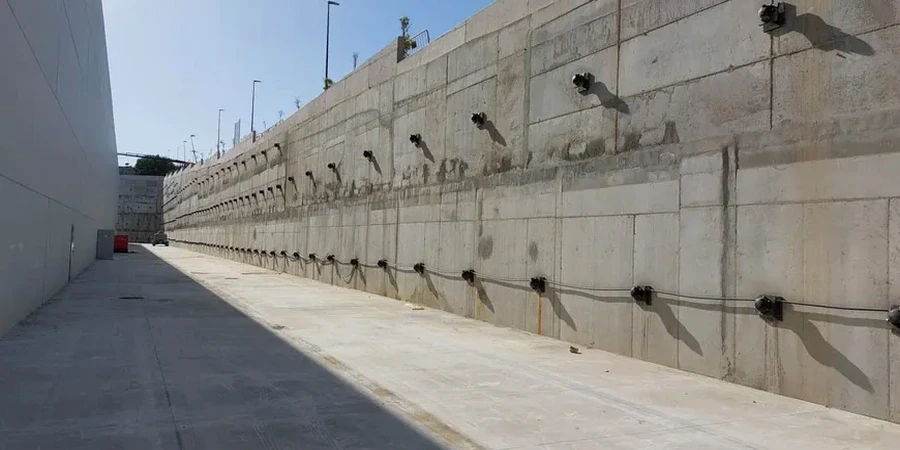
A common mistake on Miami excavation projects is treating anchor bond lengths as if they were installed in competent granite rather than the porous Miami Limestone formation. The Biscayne Aquifer sits just a few feet below the surface, meaning water pressure and solution cavities directly affect grout-to-ground bond stress. Teams that skip a site-specific anchor test program often face creep failures during the wet season when the water table rises. We approach each project with a clear methodology: characterize the subsurface through drilling, compute the unbonded and bonded lengths per PTI recommendations, and verify capacity with performance tests. For deep excavations near Biscayne Bay, we frequently pair the anchor design with a deep excavation monitoring plan to track wall deflection in real time.
Anchor capacity in Miami limestone is governed more by grout penetration into vuggy porosity than by the steel tendon's ultimate tensile strength.
Site-specific factors
Section 1810 of the IBC and the Florida Building Code require full-scale field testing on production anchors when the ground conditions are variable — and in Miami, karst is variable by definition. The biggest risk is a sudden loss of grout into a solution cavity during installation, which can leave the bond zone unpressurized and the anchor non-functional. If the cavity connects to the aquifer, it can also create a direct pathway for saltwater intrusion, compromising the grout durability over time. A progressive anchor failure in a tied-back wall for a downtown Miami high-rise foundation can delay the entire project and require costly dewatering and re-drilling. That is why we enforce a proof test on every anchor and a performance test on at least five percent of the total quantity, following the PTI acceptance criteria for creep and load-extension behavior.
Relevant standards
IBC 2021 – Section 1810 Anchors, PTI DC35.1-14 Recommendations for Prestressed Rock and Soil Anchors, Florida Building Code – High-Velocity Hurricane Zone provisions, ASTM A615 – Deformed and Plain Carbon-Steel Bars for Concrete Reinforcement, ASTM A416 – Low-Relaxation, Seven-Wire Steel Strand for Prestressed Concrete
Common questions
How much does an anchor design package cost for a mid-size excavation in Miami?
For a project with 30 to 50 anchors, the engineering design, test program specification, and field verification typically range from US$1.050 to US$4.200, depending on the number of borings required and the complexity of the corrosion protection needed near the coast.
What is the difference between active and passive anchors in a Miami context?
Active anchors are tensioned to a design load before the excavation proceeds, which minimizes wall deflection — critical when adjacent to sensitive structures in Brickell or downtown. Passive anchors are not prestressed; they engage once the soil or rock mass starts to move, and are more common for temporary cuts where some deformation is acceptable.
Does the high water table in Miami affect anchor performance?
Absolutely. The water pressure reduces effective stress in the bond zone, and the flow through solution cavities can dilute the grout during installation. We specify a fluid loss additive in the grout mix and often require a pre-grouting phase to seal the cavities before the structural tendon is installed, ensuring a continuous, dense bond zone.